
Solar Monitoring — Track Your System's Performance Anywhere
See exactly how much your system is generating, catch faults early, and confirm your solar investment is delivering the output it was designed for.
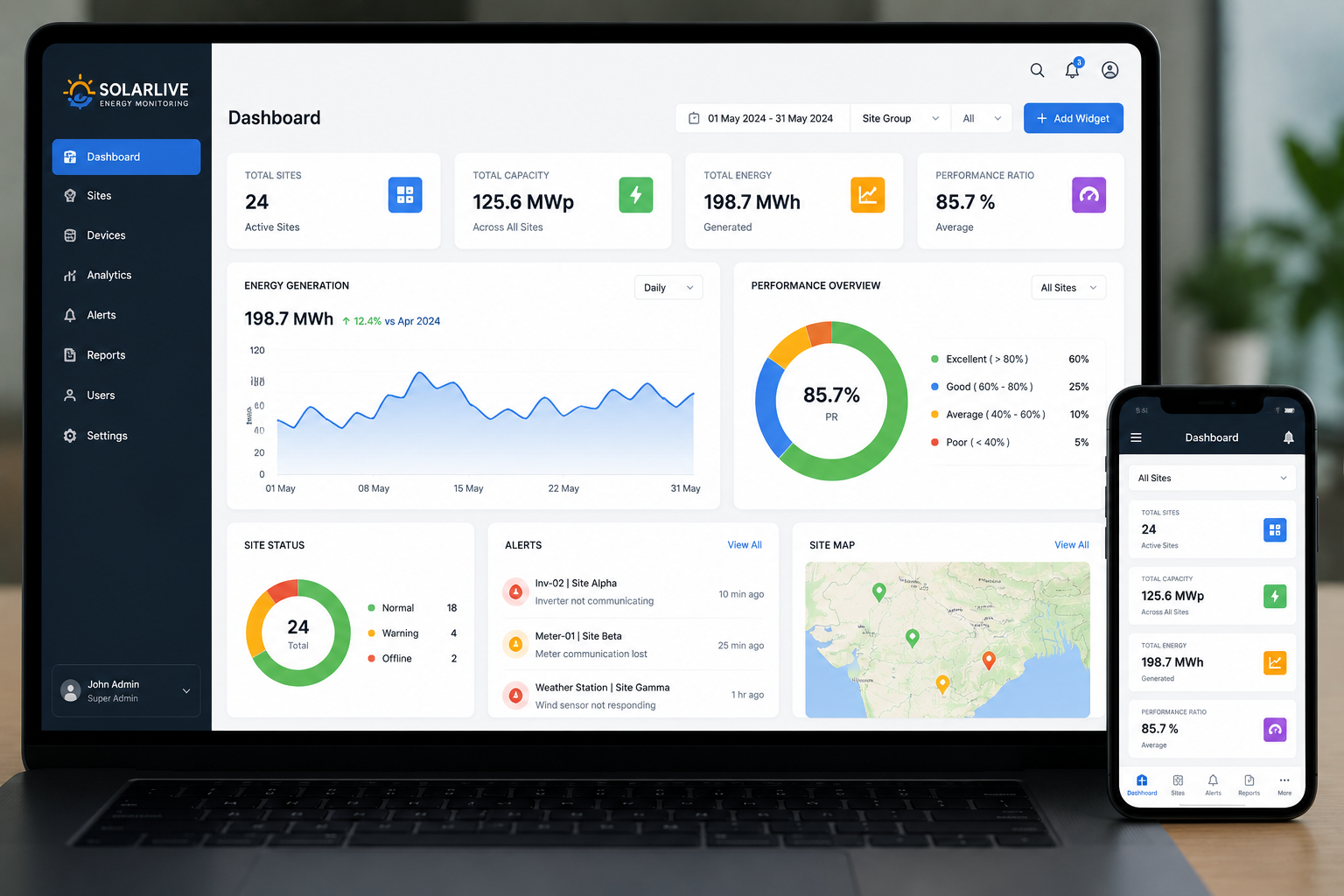
Visibility Into Every Unit Your System Generates
Solar monitoring turns your inverter's internal generation data into an accessible mobile app or web dashboard, giving you real-time and historical visibility into how much power your system is producing. Beyond satisfying curiosity, monitoring plays a practical role in verifying your system is performing close to its design expectations, catching faults or underperformance early (before they translate into significant lost savings), and providing the data needed for maintenance teams to diagnose issues remotely before an on-site visit.
Product Categories
Mobile App Monitoring
Most modern inverters connect via WiFi or GSM to a manufacturer app showing daily, monthly and lifetime generation.
Web Dashboard Monitoring
Browser-based dashboards, useful for commercial and industrial customers tracking multiple sites or larger data sets.
Fault Alert Systems
Automatic notifications when the system detects an inverter fault, string underperformance, or a communication loss.
Multi-Site Dashboards
Consolidated views for businesses or portfolio owners managing several installations from one login.
How It Works
Your inverter's internal data logger records generation metrics and transmits them via WiFi, GSM, or a wired connection to a cloud platform, which processes the data into the visualisations shown on your mobile app or web dashboard. Alerts are triggered automatically when the system detects readings outside expected parameters, such as a sudden drop in output from one string or a loss of communication with the inverter.
Ask a Product Question
Our solar engineers can help you choose the right option.
What Makes This Product Reliable
Specification Overview
Indicative ranges — exact specifications vary by selected brand and model.
| Feature | Typical Availability | Value to You |
|---|---|---|
| Real-Time Generation Display | Standard on most modern inverters | Confirms the system is actively producing power |
| Historical Data & Reports | Standard on most monitoring platforms | Tracks performance trends over time |
| Fault Alerts | Standard on most monitoring platforms | Flags issues early, before major output loss |
| Performance Ratio Tracking | Available on most mid-to-high tier systems | Compares actual vs. expected generation |
| Multi-Site Dashboard | Typically available for commercial/industrial tiers | Consolidated view across multiple locations |
| Data Connectivity | WiFi, GSM/SIM, or wired, depending on inverter model | Determines reliability of data transmission at your site |
Available Capacity Options
| Capacity / Model Range | Typically Suitable For | Notes |
|---|---|---|
| Residential Systems | Standard mobile app monitoring included with most inverters | Sufficient for typical home tracking needs |
| Commercial Systems | Web dashboard with performance-ratio tracking recommended | Supports business-level reporting needs |
| Industrial Systems | Comprehensive monitoring with multi-string diagnostics | Matched to plant engineering and facilities workflows |
| Multi-Site Portfolios | Consolidated multi-site dashboard | Single login across several installations |
How to Choose the Right Option
For most residential systems, the monitoring app bundled with your inverter is sufficient. Commercial and industrial customers, or anyone managing multiple sites, should look for a platform offering performance-ratio tracking and multi-string diagnostics rather than basic generation totals alone — this level of detail is what allows early fault detection rather than only noticing a problem once your bill unexpectedly increases.
Compatibility Information
Monitoring capability is generally tied to your specific inverter brand and model — connectivity method (WiFi vs. GSM) should be chosen based on your site's internet reliability, which we assess during system design.
Warranty Information
Monitoring hardware (communication modules) is typically covered under the inverter's overall product warranty; the monitoring software/app service itself is usually provided by the inverter manufacturer at no separate recurring cost, though this varies by brand.
Maintenance Information
Monitoring systems need little direct maintenance beyond ensuring stable connectivity (WiFi signal or SIM card status); our maintenance visits include a check of monitoring connectivity as standard.
Buying Considerations
When comparing inverter brands, ask specifically what monitoring features are included versus what requires an additional subscription or hardware purchase — this varies meaningfully between manufacturers and is easy to overlook when comparing quotes on price alone.
Common Use Cases
Related Products
Solar Monitoring — Frequently Asked Questions
Most modern inverters include basic mobile app monitoring as standard; more advanced multi-site or performance-ratio dashboards may be an additional feature depending on your inverter brand and tier.
Performance ratio compares your system's actual generation against its theoretical maximum output under the sunlight conditions recorded at your site, helping identify whether your system is underperforming its potential.
This depends on your specific platform's alert configuration, but most systems can flag communication loss or significant output anomalies within hours to a day, allowing prompt investigation.
Yes — our maintenance team reviews monitoring data before a visit where possible, which often helps diagnose the likely cause of an issue before arriving on-site.
Most inverters support both WiFi and GSM/SIM-based connectivity; for sites with unreliable WiFi, a GSM-based monitoring option is often more suitable, discussed during system design.
Yes, many monitoring platforms — particularly those aimed at commercial and industrial customers — support a consolidated multi-site dashboard from a single login.
Your system continues generating power normally even if the monitoring connection is interrupted; only the visibility into that generation is temporarily affected until connectivity is restored.
Historical generation data can be useful supporting documentation in various contexts, though specific requirements vary — check with the relevant authority or your finance provider for what documentation they require.
This depends on the specific monitoring platform's configuration options; many allow adding multiple email addresses or users, useful for businesses with a facilities team.
This varies by inverter manufacturer — many include basic app monitoring at no additional recurring cost, while advanced dashboard features may involve a subscription; we clarify this for your specific chosen inverter.
Enquire About Solar Monitoring
Share your requirement and we'll recommend the right option for your system.